Industrial Pallet Racking Beams: A Technical Guide to Structural Design and Storage
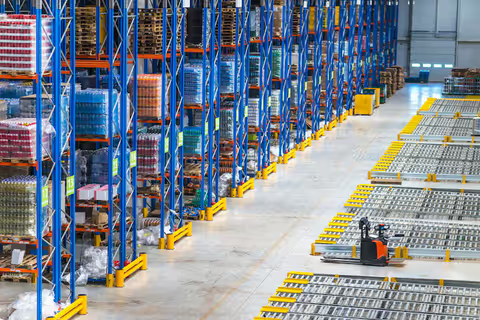
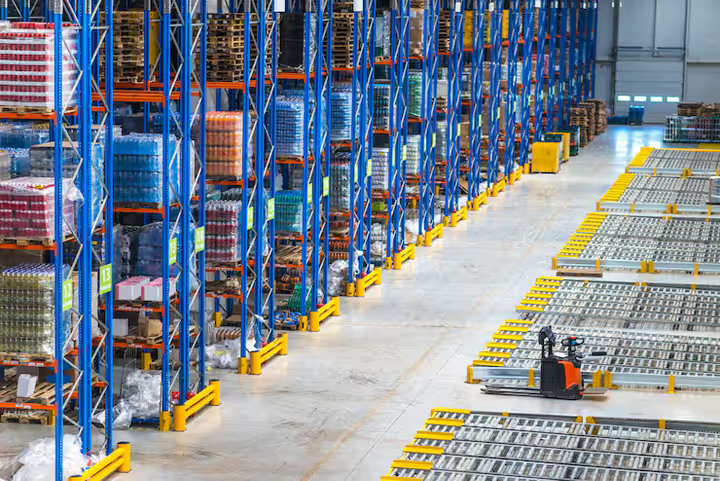
Industrial pallet racking beams are horizontal structural components used in pallet storage systems to support loads between upright frames. Pallet racking beams form the main load-supporting levels in many warehouse layouts and are commonly used with industrial pallet rack beams, upright columns, connectors, and safety accessories.
Together, these components create industrial storage rack systems that help organize palletized goods and make better use of vertical warehouse space.
Context
What Are Pallet Racking Beams?
Pallet racking beams are horizontal members fitted between vertical upright frames. Pallets rest directly on the beams or on supporting elements connected to them. The beams transfer the weight of stored materials toward the upright frames and ultimately to the warehouse floor.
The basic concept developed from the need to store goods in organized vertical levels rather than placing every pallet directly on the floor. As warehouses became larger and material handling equipment became more capable, rack systems evolved to accommodate different pallet sizes, load weights, aisle arrangements, and handling methods.
Industrial pallet racking beams are generally manufactured from formed or rolled steel. Their dimensions, profile, connection method, and material thickness vary according to the intended load and rack configuration.
How a Pallet Rack System Is Structured
A conventional pallet rack contains several interconnected components. Upright frames provide vertical support, while pallet racking beams create horizontal storage levels. Bracing members help maintain the geometry of the frames.
Other components can include:
- Upright frames and columns
- Horizontal pallet rack beams
- Beam connectors and locking mechanisms
- Floor anchors
- Pallet supports
- Row spacers
- Wire decking or steel decking
- Column guards and other protective equipment
The combination of these components determines how a storage rack behaves under load. A beam should therefore be considered as part of a complete rack structure rather than as an isolated component.
Common Beam Profiles
Industrial pallet rack beams can have different cross-sectional shapes. Box beams, step beams, structural beams, and other profiles are used depending on the rack design and loading requirements.
A step beam may have a recessed section that accommodates pallet supports or decking. Structural beams may be used in configurations requiring different structural characteristics. The appropriate profile depends on engineering calculations, rack geometry, connection details, and the intended application.
Importance
Why Pallet Racking Beams Matter
Warehouses handle products with different weights, dimensions, and storage requirements. A properly designed rack system provides defined storage positions and helps separate pedestrian areas, equipment routes, and pallet locations.
Industrial pallet racking beams are particularly important because they carry the horizontal storage loads. Beam dimensions and spacing influence the amount of weight that can be placed at each level.
Incorrect loading, impact from forklifts, damaged components, or changes to the original rack configuration can affect structural performance. For this reason, rack inspection and load management are important parts of warehouse safety.
Heavy-Duty Pallet Racking
Heavy duty pallet racking is designed for applications involving substantial pallet loads and frequent material handling. Such systems can be found in manufacturing facilities, distribution centers, cold-storage warehouses, automotive facilities, and other industrial environments.
The term "heavy duty" does not represent one universal load rating. Actual capacity depends on the beam dimensions, steel properties, span, upright design, number of storage levels, pallet arrangement, floor conditions, and other structural factors.
A load-rating table for a rack should therefore be based on the specific system design rather than a general assumption.
| Rack component | Main function | Factors affecting capacity |
|---|---|---|
| Upright frame | Transfers loads toward the floor | Height, profile, bracing, steel properties |
| Pallet rack beam | Supports pallets between frames | Span, section profile, material, connections |
| Pallet support | Supports pallet boards between beams | Pallet design and support spacing |
| Decking | Provides a continuous storage surface | Material, span, distributed load |
| Floor anchor | Connects rack to the floor | Anchor type, floor condition, installation |
| Column guard | Helps protect uprights from impacts | Guard design and placement |
Supporting Industrial Storage Operations
Industrial pallet storage solutions can help warehouses organize stock by product category, batch, destination, or handling requirements. Rack levels can also make vertical space usable while maintaining defined aisles for forklifts and other material-handling equipment.
The arrangement must account for the type of pallets being stored. Standardized pallet dimensions can simplify rack planning, while mixed pallet sizes may require different beam spacing or storage configurations.
Recent Updates
Changes in Warehouse Design
From 2024 through 2026, warehouse storage design has increasingly been influenced by automation, inventory visibility, and changing distribution patterns. These developments have encouraged facilities to consider rack layouts alongside conveyors, automated guided vehicles, robotic systems, and warehouse management software.
Industrial storage rack systems are therefore increasingly designed as part of a wider material-handling environment. Rack positions may be planned around equipment travel paths, barcode scanning points, automated storage equipment, and defined loading zones.
Automation and Rack Integration
Automated warehouses can use pallet racks together with cranes, shuttle systems, robotic equipment, and other automated handling technologies. In these environments, beam placement and rack tolerances may need to meet specific equipment requirements.
Automation does not eliminate the importance of structural safety. Instead, it can introduce additional requirements concerning rack geometry, aisle dimensions, sensor locations, pallet positioning, and equipment clearance.
Inspection and Digital Records
Digital inspection tools are also becoming more common in warehouse operations. Inspection records can document rack identification, observed damage, corrective actions, and inspection dates.
Some facilities use digital photographs, mobile forms, asset identifiers, or warehouse management platforms to maintain records. These tools can make it easier to track individual rack locations and identify recurring damage patterns.
Laws or Policies
Warehouse Safety in India
In India, warehouse rack safety is influenced by occupational safety requirements, building regulations, fire-safety provisions, and applicable technical standards. The Occupational Safety, Health and Working Conditions Code, 2020 provides a broader framework concerning workplace health and safety, subject to its implementation and applicable rules.
The National Building Code of India also contains provisions relevant to building safety, structural considerations, fire protection, and industrial facilities. Specific requirements can vary according to the building, occupancy, location, and local authority.
Standards and Engineering Practices
Indian Standards may apply to structural steel, storage equipment, materials, and related engineering practices. Depending on the rack design and application, designers may also refer to recognized international rack standards.
Warehouse operators generally need to consider:
- Rated load information for rack components
- Structural design and installation requirements
- Floor capacity and anchoring
- Forklift operating practices
- Fire protection and aisle requirements
- Routine inspection and maintenance records
- Procedures for damaged rack components
Rack capacity should be established using engineering documentation for the actual configuration. Replacing beams or changing storage levels can alter the original structural design and should be evaluated accordingly.
Tools and Resources
Rack Planning Tools
Several tools can help with warehouse rack planning and assessment. CAD software and warehouse-layout applications can be used to create rack arrangements, aisle dimensions, pallet positions, and equipment paths.
Load calculations are another important resource. These calculations consider variables such as pallet weight, beam span, storage levels, load distribution, and rack geometry.
Inspection and Documentation Resources
Warehouse operators can use inspection checklists to record the condition of beams, uprights, connectors, anchors, decking, and protective components. Documentation can include:
- Rack identification numbers
- Beam and upright condition
- Visible deformation
- Missing or damaged locking components
- Anchor condition
- Signs of impact
- Load-label information
- Inspection date and follow-up actions
Selecting Pallet Rack Beams
Pallet rack beam manufacturers generally design beams according to specific structural and application requirements. When evaluating industrial pallet rack beams, important technical information includes beam length, profile, steel specification, connection type, intended load, and compatibility with the upright frame.
A beam from one rack configuration should not automatically be assumed to be interchangeable with a beam from another system. Connection geometry, dimensions, loading, and structural calculations all matter.
FAQs
What are industrial pallet racking beams used for?
Industrial pallet racking beams provide horizontal support for pallets stored between upright frames. They form the storage levels of many warehouse pallet rack systems and transfer loads toward the supporting frames.
How are pallet racking beams rated?
Beam capacity depends on factors such as beam span, cross-sectional profile, steel properties, connection design, load distribution, and the overall rack configuration. A stated capacity should correspond to the specific rack design rather than a general beam category.
What should pallet rack beam manufacturers consider?
Pallet rack beam manufacturers consider the required span, load conditions, steel properties, beam profile, connector design, rack geometry, and applicable engineering requirements. Compatibility with the associated upright frames is also important.
What is heavy-duty pallet racking?
Heavy-duty pallet racking refers to rack systems designed for substantial pallet loads. The actual capacity varies according to the structural design, beam and upright dimensions, storage height, pallet arrangement, and floor conditions.
How do industrial storage rack systems improve warehouse organization?
Industrial storage rack systems create defined pallet locations and use vertical warehouse space. Their layouts can be arranged around product categories, inventory flow, forklift routes, loading areas, and automated material-handling equipment.
Conclusion
Industrial pallet racking beams are key horizontal components that support pallet loads within warehouse rack structures. Their capacity and suitability depend on beam dimensions, materials, span, connections, upright frames, loading patterns, and the overall rack design. Recent warehouse developments have connected pallet storage with automation, digital inventory systems, and more structured inspection processes. In India, rack installations also need to be considered alongside applicable workplace, building, fire-safety, and engineering requirements.