A Guide to Data Center Substation Transformers and Electrical Distribution
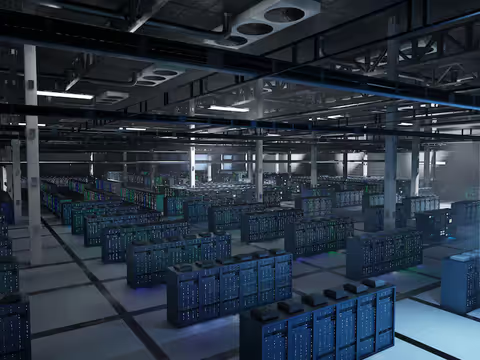
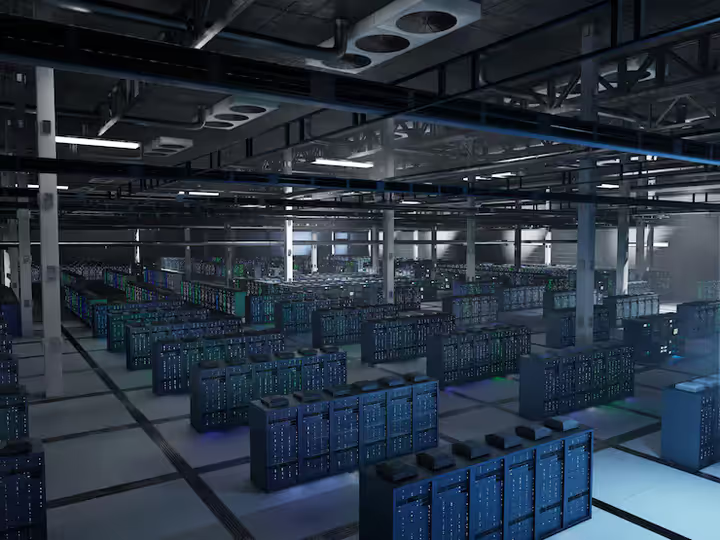
Data center transformer equipment forms an important part of the electrical infrastructure that keeps computing facilities supplied with stable power. Data center transformers, substation transformers for data centers, switchgear, protection systems, and distribution equipment work together to move electricity from the utility connection toward servers, cooling systems, lighting, and other loads.
As data centers expand their computing capacity, understanding how these electrical systems function has become increasingly important for facility planners, engineers, operators, and the general public.
Context
What Is Data Center Substation Transformer Equipment?
Data center substation transformer equipment refers to electrical equipment used to receive, transform, control, protect, and distribute electrical power within or near a data center facility. A transformer changes electrical voltage from one level to another so that power can be transferred and distributed according to the requirements of different parts of the facility.
A typical electrical path may begin at a utility transmission or distribution connection and continue through transformers, switchgear, protection devices, distribution boards, backup power systems, and finally the equipment supplying computing and building loads.
Data center power transformers can be designed for different voltage levels and load conditions. Their selection depends on factors such as electrical capacity, expected load growth, cooling requirements, site conditions, redundancy arrangements, and the characteristics of the local utility network.
How Transformers Fit Into a Data Center
A data center generally contains several electrical stages rather than one transformer working alone. The arrangement varies according to facility size and design.
Common components include:
- Utility connection equipment for receiving incoming electrical power.
- Substation transformers for changing voltage levels.
- Medium-voltage switchgear for switching and protecting electrical circuits.
- Low-voltage distribution equipment for supplying building loads.
- Uninterruptible power systems for maintaining power during short interruptions.
- Backup generators for longer interruptions.
- Busways, panelboards, and other distribution equipment for delivering electricity to individual loads.
This arrangement creates a coordinated electrical network. Engineers design the system so that equipment can be isolated during maintenance while important loads continue receiving power through another available path where the facility design permits it.
Common Transformer Types
Different transformer configurations can be used depending on the electrical architecture. Oil-immersed transformers are commonly associated with substations and outdoor installations, while dry-type transformers may be suitable for certain indoor applications.
The main distinction involves the insulation and cooling method. Transformer selection also considers voltage, capacity, ambient conditions, fire-safety requirements, available space, maintenance arrangements, and applicable electrical standards.
| Equipment | Main Function | Typical Location |
|---|---|---|
| Power transformer | Changes medium or high voltage | Substation |
| Distribution transformer | Converts voltage for facility loads | Electrical distribution area |
| Dry-type transformer | Voltage transformation without liquid insulation | Indoor electrical rooms |
| Oil-immersed transformer | Voltage transformation with liquid insulation and cooling | Outdoor or dedicated substation |
| Switchgear | Controls and protects electrical circuits | Substation or electrical room |
| UPS transformer | Supports specific power distribution arrangements | UPS or electrical area |
Importance
Supporting Continuous Computing Operations
Modern data centers can contain large numbers of servers, networking devices, storage systems, cooling equipment, pumps, lighting systems, and monitoring equipment. These loads require carefully designed electrical distribution because interruptions or electrical disturbances can affect computing operations.
Data center electrical infrastructure therefore extends beyond transformers. It includes power distribution equipment, protection systems, grounding arrangements, backup systems, monitoring devices, and control systems.
The transformer is an important link because an unsuitable voltage level, inadequate capacity, or poorly coordinated protection arrangement can create electrical operating challenges. Engineers consider the complete power path rather than treating the transformer as an isolated component.
Managing Increasing Electrical Loads
Artificial intelligence computing, cloud platforms, digital services, and high-density computing can increase electricity requirements within data centers. High-performance computing equipment may also create concentrated electrical loads in specific areas of a facility.
This trend has increased attention toward transformer capacity, electrical efficiency, redundancy, thermal management, and expansion planning. Data center power systems engineering increasingly considers present requirements together with anticipated changes in computing density.
Improving Electrical Resilience
Data centers often use multiple electrical paths, backup generators, UPS systems, and other protective arrangements. The exact configuration depends on the facility's operational requirements and the level of redundancy selected during design.
Electrical resilience involves more than having backup equipment. Protection coordination, transformer monitoring, maintenance procedures, physical separation, grounding, and appropriate switching arrangements all contribute to the overall design.
Recent Updates
Higher-Density Computing
From 2024 through 2026, data center development has increasingly been influenced by artificial intelligence, cloud computing, and accelerated computing workloads. These applications can require greater electrical capacity within relatively concentrated areas.
As a result, data center transformers are increasingly considered alongside higher-capacity distribution systems and changes in rack-level electrical demand. Facility designs may need additional attention to transformer loading, heat management, short-circuit levels, and expansion capacity.
Digital Monitoring
Another continuing development is the use of digital monitoring in electrical infrastructure. Sensors and monitoring systems can collect information about transformer temperature, load, voltage, current, insulation conditions, and other operating parameters.
Digital monitoring can help operators identify changes in equipment behavior and support maintenance planning. However, sensor readings still need to be interpreted within the context of the equipment design and operating conditions.
Modular Electrical Architecture
Some new data center projects use modular electrical designs in which power infrastructure is arranged in repeatable sections. Modular approaches can simplify expansion planning because additional electrical capacity may be integrated in stages.
The suitability of a modular architecture depends on the site, utility connection, facility layout, equipment specifications, and applicable electrical requirements.
Renewable and Low-Carbon Power Integration
Data center development is also increasingly connected with renewable electricity, battery systems, and broader grid-management strategies. These changes can affect how electrical systems are planned, particularly where facilities combine utility power with on-site generation or energy storage.
Transformers and switchgear must be compatible with the electrical characteristics of the selected generation and distribution architecture.
Laws or Policies
Indian Electrical Requirements
In India, data center electrical infrastructure is shaped by national electrical rules, Central Electricity Authority requirements, Bureau of Indian Standards publications, state-level electrical regulations, and applicable building requirements.
The Central Electricity Authority's safety-related regulations establish requirements concerning electrical installations and protection. Depending on the project, additional requirements may apply to high-voltage installations, substations, earthing, clearances, protection, testing, and electrical safety.
BIS and Technical Standards
Bureau of Indian Standards publications provide technical requirements for various electrical products and installations. Transformer and switchgear specifications can be evaluated against applicable Indian Standards, while international standards may also be referenced where appropriate to a particular project.
Building projects can also be subject to the National Building Code of India and local approval requirements. The exact rules applicable to a data center depend on its location, voltage level, configuration, and project characteristics.
Electrical Safety and Approvals
Data center projects involving substations and high-voltage equipment generally require coordination with relevant electrical authorities and utilities. Requirements may include design documentation, inspection, testing, protective arrangements, and approval procedures.
Because regulations can change and project requirements vary by state and installation type, current requirements should be verified with the relevant authority and qualified electrical professionals.
Tools and Resources
Transformer Sizing Resources
Transformer sizing calculations commonly consider connected load, demand load, diversity, power factor, expected expansion, and operating conditions. Electrical engineers may use load schedules and engineering calculation software to estimate transformer capacity.
A simplified planning relationship is:
Apparent Power (kVA) = Real Power (kW) ÷ Power Factor
Actual transformer selection requires additional technical considerations beyond this basic calculation.
Electrical Monitoring Tools
Power quality analyzers, thermal monitoring equipment, insulation testing instruments, and transformer monitoring systems can provide information about electrical operating conditions.
Useful information may include:
- Voltage and current measurements
- Transformer temperature
- Load levels
- Frequency
- Harmonic distortion
- Power factor
- Energy consumption
- Protective device status
Standards and Reference Resources
Organizations such as the Bureau of Indian Standards, Central Electricity Authority, International Electrotechnical Commission, Institute of Electrical and Electronics Engineers, and local electricity distribution authorities provide technical information relevant to electrical infrastructure.
Manufacturers' technical documentation can also provide transformer ratings, installation requirements, environmental limitations, testing information, and protection details. Such documentation should be evaluated alongside applicable codes and engineering specifications.
FAQs
What is data center transformer equipment?
Data center transformer equipment includes transformers used to change electrical voltage levels within a facility's power distribution network. It works with switchgear, protection devices, distribution systems, UPS equipment, and other electrical infrastructure.
Why are data center power transformers important?
Data center power transformers allow electrical power received at one voltage level to be distributed at levels appropriate for different facility loads. Their capacity and configuration form part of the wider data center electrical infrastructure.
What are substation transformers for data centers?
Substation transformers for data centers are transformers installed within or near an electrical substation that supplies the facility. They can reduce or otherwise transform incoming voltage to levels required by the site's distribution architecture.
How is data center power distribution equipment monitored?
Monitoring can include measurements of voltage, current, load, temperature, frequency, power factor, and other electrical conditions. Digital monitoring systems can collect this information for operational analysis and maintenance planning.
What should be considered when designing data center power systems engineering?
Important considerations include electrical load, redundancy, transformer capacity, protection coordination, grounding, short-circuit levels, cooling, physical space, maintenance access, expansion requirements, and applicable regulations. The final design depends on the specific facility and utility connection.
Conclusion
Data center transformer equipment is a central part of the electrical infrastructure used to distribute power to computing and building systems. Data center transformers work alongside switchgear, protection equipment, UPS systems, generators, and distribution networks to form an integrated power architecture. Recent developments in high-density computing, digital monitoring, modular construction, and renewable energy integration are influencing how these systems are designed. In India, electrical installations are also shaped by applicable CEA requirements, BIS standards, building regulations, utility requirements, and local approval procedures.